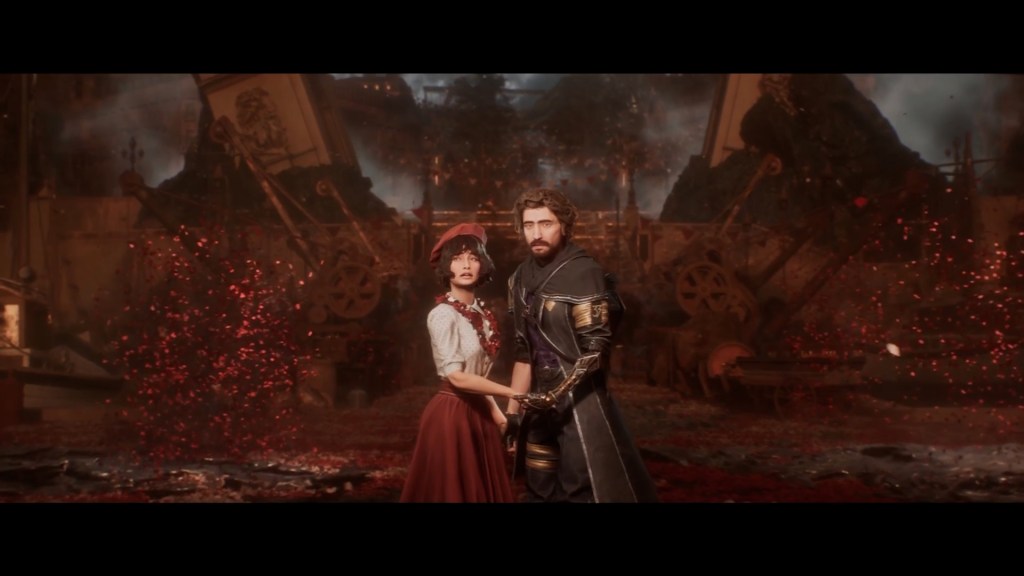
Traveling the Continent in Clair Obscur: Expedition 33 is not for the faint of heart. Every gorgeous landscape, from underwater dungeons to red-leaved forests to the ruins of Old Lumiere, is littered with corpses. They are punctured with swords and spears, strung and suspended together in bloody globs, and found in any manner of contorted shapes with faces screaming in agony. One corpse you can come across even has its head stuck in a trumpet, which is funny until you meet the enemy who plays the instrument. The failed Expeditions’ audio journals that are sometimes next to these bodies often confirm how painful and abrupt their deaths were. No matter where you look, the game is constantly emphasizing the violent ways your party can meet their demise.
However, one of my favorite examinations of this violence comes early on from Gustave, shortly after he and Lune reunite with Maelle. As he chats with his adopted sister/daughter, Gustave espouses about the insidious nature of the Gommage. He says it makes Lumiere complacent, calling the event “predictable” and “almost gentle,” and ends his thought with “The Gommage is equally violent and death… Death is just as final.”
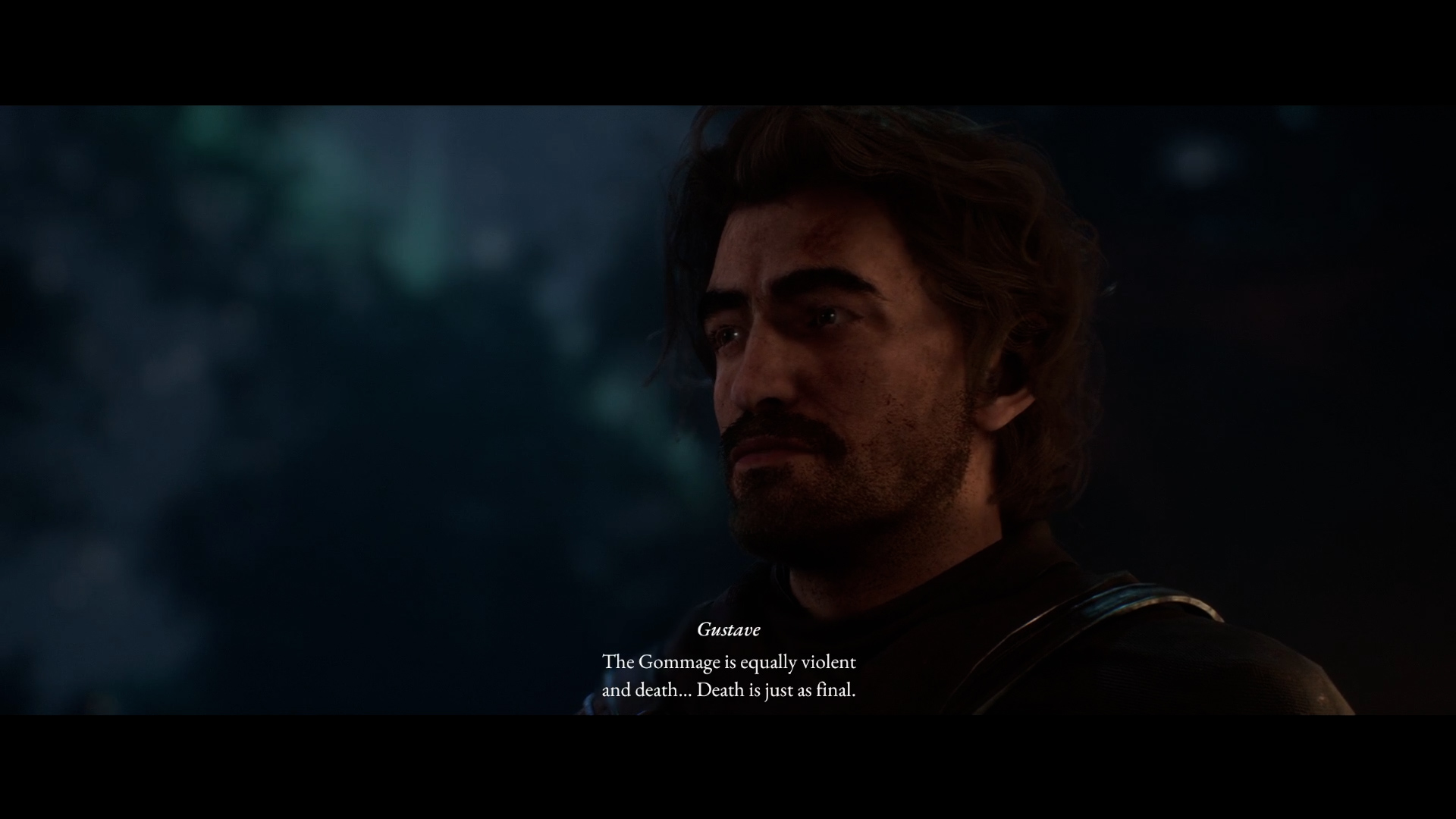
It’s important that Gustave makes this statement barely into the expedition. It acts as a reminder that while the monsters you’ll encounter are brutal, life on Lumiere can be a tortorous existence. In case you forgot, the Gommage is the annual ritual in which the Paintress dooms another age group to death. The all-powerful entity paints a new number on her canvas, and anyone older than that number dissipates into nothing. Only the red and white flower necklaces worn by those disappeared is left behind.
Watching this event in the game’s prologue is a sobering experience. As you walk through Gustave’s and Sophie’s last moments together in Lumiere, a picture emerges of a town riddled with grief and little time for hard choices. Despite knowing the gist of the game beforehand, seeing no one above the age of 34 is truly uneasy. You quickly realize this is a place where children are expected to be orphaned, to the point where whether or not to have kids is a serious ethical question. Life here is grasping at hope, when it can be found, and making peace with limited options. While there are no fist and sword duels exchanged in the opening, save for a tutorial lesson with Maelle and a harsh lesson with a Mime, Lumiere is in a constant state of violence.
Gustave’s line about the Gommage resonates with me because of how fitting it is for the world outside the screen. An initial comparison I thought of was conversations around the death penalty. While the methods of execution have attempted change even recently to make the state-sanctioned act less gruesome (emphasis on attempted), no alternatives (or clemencies in place of abolishment) change the end result for those on death row. A person is killed. Their demise has been dulled out by whoever is in power, often biased people who think and act in broad strokes, with track records across nations revealing that those sentenced can be doomed by dubious evidence. But, the thread I want to tug on now is broader in scope. What Gustave’s line highlights is that violence doesn’t need to shed blood or leave a mark. He centers the impact rather than the action, instantly framing the Continent’s hostility less as a special circumstance and more as the most extreme elements of an ongoing experience.
In several ways, this logic can apply to the lived reality of millions across the world. Many people will be able to call a shooting violent, but hesitate to attach that label to a denial of insurance claims for necessary medical treatments. They can understand how punching someone in the stomach is violent, but fumble to make the same claim when food is priced out of a person’s means. They know robbing a house of its valued possessions is violent, but don’t consider raising rent and forcing people onto the streets to be equally so. All of these actions are violent, and can cause deaths equally final.
For all the damage I have taken from swords, spears, needles, and spells, it is the Gommage that remains one of the most singularly violent acts in Clair Obscur: Expedition 33. While I understand the prologue’s efficacy to elicit emotion may feel overstated as time has passed, I’ve only grown further towards it being an incredibly impactful opener. The carnage Expedition 33 is immediately met with on the Continent is shocking and unlike anything they’ve ever seen, but it is not wholly unfamiliar. The Gommage also rips people and families apart. The Gommage also leaves people shocked and grieving. The Gommage is equally violent, and I hope that line sat with others players too.


 Exalclaw
Leave a reply to May 11th – Critical Distance Cancel reply