Love is the only thing I truly believe could make someone defy death, even with its track record of leading so many to theirs. It’s proven time and again how powerful a force it is, how it can make people do the impossible. Love has a sharpness that makes every gust of it shave away at a person’s very being. It is an unraveller like no other, revealing layers of ourselves that fundamentally change our self-understanding. It’s one of the few things capable of truly remaking us, often for the better when loved well and honestly.
But also, love fucking sucks. It heightens every insecurity, turns misunderstandings into apocalyptic prophecies. It pushes absence down throats and makes people choke on words that don’t make sense, can’t make sense, unless they are vomited at the feet of people who may never come back. It undoes people and makes them horrifying strangers to themselves, every limb puppeted by someone who may or may not feel the strings running from their fingers.
When love is real, it’s everything and everlasting — some part of you will be changed forever. Some part of you will hurt forever too. And this is the side that Love Eternal occupies itself with.
Developed by brlka and published by ysbryd games, Love Eternal shows how love can hurt relentlessly. It is a message drilled into players both in unforgiving form and purposely-vague content. As the protagonist Maya finds herself thrown into a mysterious castle called Shelter, constructed and haunted by a Goddess that conjured the superstructure from her grief-stricken mind, what starts as an unforgiving platformer quickly reads as a brutally honest reflection on love’s nastiest consequences.
It is fitting that Love Eternal’s cruel lens on love is, at first, taught through a near-torturous platformer. If someone were to teach another how to survive difficult platformers or love, the same advice could be repurposed: you will need a monumental amount of patience. You must become a master of the small details, dedicated to understanding a space so well that you could become its cartographer. You must gain a fluency, or at least above average understanding, of a new language that may or may not overlap with ones you already know. And you will need the capacity to kill versions of yourself, often, if you ever want to progress toward something rewarding.
Jumping around Shelter requires all of the above and then some. It is not only a platformer but also a puzzle, its mechanic that lets players reverse gravity and fall upwards once per jump — with additional uses possible if Maya hits a red stone mid-air — turning most levels into tests of both dexterity and deduction. The gravity ability in of itself has a weightiness that requires incessant trial and error to master, a design choice that risks alienating even veteran platforming enthusiasts who are used to a precision that lets them stop when they want and continue how they like. But that’s the catch: this game isn’t about what the player wants, it’s about navigating a mind that often misunderstands love and isn’t open to change nor critique. By the time credits roll, this ability lands less as a misfire, more as precision spoken in a different language.

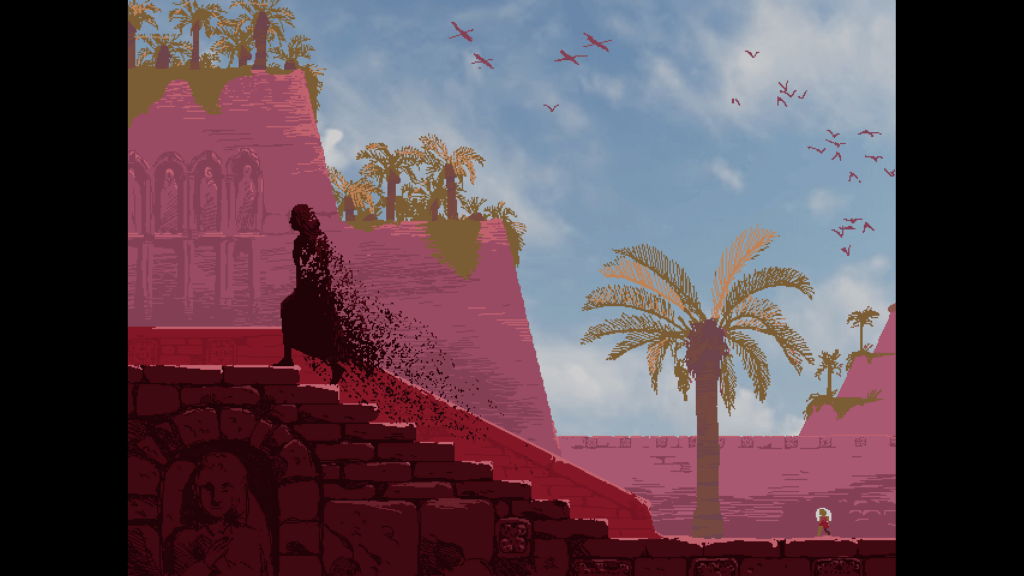
Despites it difficulty and tricky movement, Love Eternal doesn’t paint a wholly unwelcoming picture of love. For starters, the game itself isn’t too hard to love. The odd architecture of Shelter is arresting, convoluted in a way that beckons players in rather than drive them away. The landscapes backdropping the many deaths that’ll be experienced are equally gorgeous. At times, they also create a striking contrast as scenes of suburbia are foregrounded by lethal spikes and lasers; a commentary on the illusion of peace in these homes — the poster children of where healthy love leads — and a visual statement that says navigating these streets can feel just as treacherous as Shelter’s inner workings.
This exercise in patience is also very generous with save points. Their placement ensures progress isn’t just imaginable — it is visibly within reach. It turns the save points into invitations to try again; signs that there can be an end to any specific torment so long as you’re willing to be persistent. However, this generosity doesn’t make Love Eternal and its idea of love any less cruel. The love that hurts the most isn’t the one that completely shuts the door in your face, but instead the one that leaves it a bit ajar so you can peek in, so you can keep hurting yourself while believing all hope isn’t lost for whatever that relationship could be. Sometimes it’s worth it, sometimes not. Regardless, the hurt will last longer in the end.
Speaking of hurt, that’s the key to being swallowed by this specific castle. Narratively, the common denominator between Maya and other kidnappees, the signal that led the Goddess to mistaking them as kindred spirits/potential friends and trapping them in Shelter, was a type of hurt: loneliness. While loneliness is not intrinsically attached to love, the latter’s absence and/or departure has a knack for multiplying the former’s power. The platformer does nothing to disprove this. In fact, the catalyst for Maya’s story was a love lost ages ago: a Goddess found herself, deservingly or otherwise, betrayed by those she trusted, exiled from home with only her loyal dog Sweetie, and finally left alone once Time did what it always will and took Sweetie away. By the time Love Eternal starts, she is already a being who has succumbed to grief and become trapped in her own mind, calling her brain-child of a castle Shelter despite Prison being a more fitting name.
The Goddess is not a good being. She has ripped people away from their lives with the express intent of replacing them, playing house in the real world like any good lonely child does, while also dominating her victims’ time inside Shelter. But, like any memorable villain, she is also too relatable. Nowhere is this more evident than the game’s sudden transformation into a point-and-click during the second half. These sections can be interpreted as the final layer of entrapment in Shelter, the moment where the Goddess has taken near-complete control of another’s mind, visualized by the victim being physically cased inside a dog statue after the Goddess touches them.
While disorienting, the genre change is a brilliant way to actualize the Goddess’ understanding of love. By forcing players from a platformer that allowed them relatively free movement to the constrained space of a point and click, the game showcases how suffocating the Goddess’ love is. In actuality, it is what love becomes when left behind by its sun, starved of others’ warmth while searching for a replacement of the irreplaceable: controlling obsession.
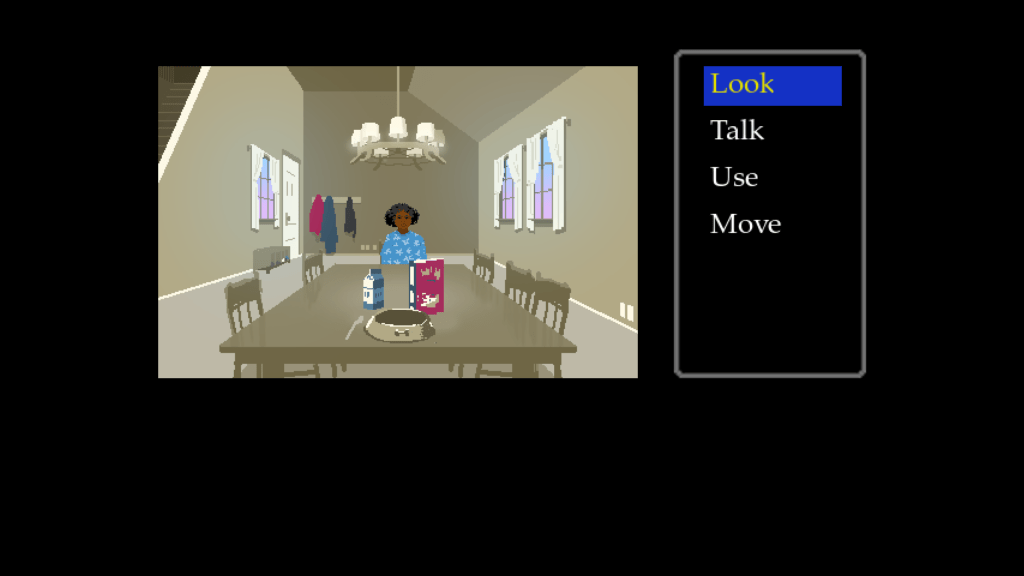
The Goddess in Love Eternal’s point-and-click section displays behavior reeking of longing for connection. Donning the appearance of Lacey, a girl that stood Maya up for a night out at the game’s start, the Goddess spends four in-game days inside a false reality trying to become Maya’s best friend — and it is hilarious. While there’s a persistent dread in the air that ensures the lump in any throat will only disappear by becoming a pit in the stomach, Goddess-Lacey’s attempts at friendship are genuinely laughable. She pretends to have the same interest as Maya in comics and manga, but ruins Maya’s manga because she thinks the story is broken. She uses memes in presentations presumably to appear more modern, if not likable. When Maya is visibly bored in the fake class setting, Goddess-Lacey pretends to need some air — an especially amusing play considering she constructed this reality, so there’s no need for this other than to maintain the illusion — and takes Maya outside with her, only to make some of the worst small talk I’ve ever seen.
What heightens the absurdity of this whole situation is Maya’s commentary. As her, players can see how horribly all of Goddess-Lacey’s courting is landing. Despite how much control Goddess-Lacey has, including a horrifying ability to alter Maya’s memories when the poorly-constructed illusion breaks, none of it is enough to balance out how off-putting her behavior is. Even under an illusion, Maya clocks the weirdo — who breaks her boundaries, knows information that wasn’t shared, and can’t take the hint to fuck off — and rejects her promises of eternal love and friendship. The whole affair shows players another ugly side of love, that being its tendency to make us look and act like desperate fools.
After experiencing all the above (as well as an utterly sadistic final challenge), one of Love Eternal’s harshest reflections on love can be found in its ending — not narratively, but metatextually. If you were to finish Love Eternal, the in-game ending of which I won’t spoil because I’m still wrapping my head around it and its implications, the game will quit without your input. When restarted, the Continue option is faded out, leaving players only with the choice to start Love Eternal anew. With a complete disregard to all the tangible progress made, it asks the player to trudge through the same apathetic trials that tormented them during the game’s (graciously) short runtime if they want to see any of Maya’s story again.
It’s another choice that is briefly disorienting, frustrating if someone wanted to re-experience specific chapters and scenes without walking through hell again, but it doesn’t detract from the game’s larger ethos. By playing it all the way through, the player has changed and been changed by the game. And if to be loved is to be changed, then to be changed is to be loved — the game itself is no exception and neither is the player. It only makes sense that for all the times Love Eternal killed the player, the player would eventually return the favor should they see the whole experience through.
Love Eternal can often be a difficult game to play and, especially in its final hour, a hard one to understand. Potentially as a result of how the story was developed, it leaves a lot unanswered, a trait that works for and against it. But if nothing else, its philosophy on love is explicit. Love is an incredible power that can lead people and gods to do the unthinkable. It changes all those who brush against it, perpetaully wrecking and building and wrecking them again. It will change you forever. No matter what, love will kill you.

 Exalclaw
Drop your thoughts!