
With blood pumping in my ears and adrenaline pounding my heart, I was feeling high after my first successful battle in Paper Cult’s demo for Tears of Metal. Despite the brief tutorial interruptions, it took little time for me to succumb to the same fervor that let the invading English and defending Scots cut each other to pieces. Playing on the side of the Scots, it was exhilarating to charge into an enemy mob and watch them go flying at the end of a combo, to block a heavy hitter and cut him down to below my size. After clearing out the area, I was raring to find a new site of death — until the game gave me 20 seconds to sit in my carnage.
I didn’t know what to expect when booting up the demo for this hack-and-slash roguelike. Hell, I didn’t even know it had those genre descriptors. When I saw the demo was available for this October’s Steam Next Fest, my mind flashed me with vague contours of a cool trailer and an intriguing art style from when I saw it during some showcase. In the demo, the artwork continued to be a highlight, as well as the electrifying opening cutscene that told the cataclysmic tale of a giant meteor called The Motherstone (or Dragon Stone Meteor in promotional material) crashing down on medieval Scotland. The meteor incited an invasion from Englishmen seduced by its mystery, which forced the native Scottish people to reclaim their land from wave after wave of enemies. While the full game will feature several playable leaders, the demo has you pick up the sword of William Wallace, son of Alan. Each run is fittingly called a campaign, where you pick your commanders and build a battalion at the start, then traverse across a map from battle to battle until you reach a boss. In the demo’s case, this was the end of Act 1’s boss and walking hill Gilles, the Hog.
I’ve really never ventured into Dynasty Warriors, Hyrule Warriors, One Piece: Pirate Warriors, or any other hack-and-slash game that fits the word “Warriors” into its title, so there’s a certain novelty to this whole experience for me. If Tears of Metal is anything like them, I can see the appeal: while it’s fairly easy to dispatch a clump of soldiers with a light or heavy attack, combat still feels engaging with the inclusion of combos that rope in a block, a dodge, and a special attack. Plus, the roguelike element of the game — where temporary boosts called Emblems are added at the end of each battle in a campaign, in addition to more permanent boosts assigned to your commanders once you win or die — helps create an enticing momentum that is aggressively met with stronger, more diverse, and more lethal enemies.
Although, the momentum isn’t entirely smooth given how each battle ends. Once the last enemy is slain, Tears of Metal doesn’t automatically usher you off to the next kill-or-be-killed fight. If you so choose, it lets you sit and observe your surroundings for 20 seconds. And wow, it’s shocking how quickly green becomes red after a battle. The bodies of your enemies do not blip out of existence like in some games, instead becoming new fixtures of the now-quiet landscape surrounding you. Drinking in this bloody sight drained the adrenaline out of my heart and replaced it with something more bittersweet, something that was redefining these bodies. I stopped seeing strictly enemies and started seeing humans. Wrong ones no doubt, but still humans. What made me further reckon with these actions was the cheer you can do after a battle. William Wallace will raise his sword and let out a throaty shout, only to be met with silence by his wandering comrades.
The whole affair is presented in such a way where I felt like they heard me, but didn’t have the will to respond anymore. It all came together to paint a sharp and clear picture of what you’re actually doing: you are not at war for glory or fame or any other trite and fleeting concept — you are fighting to survive, to exist. Factor in the soldiers and commanders that can die during a skirmish and you quickly realize there is very little to celebrate on the battlefield.
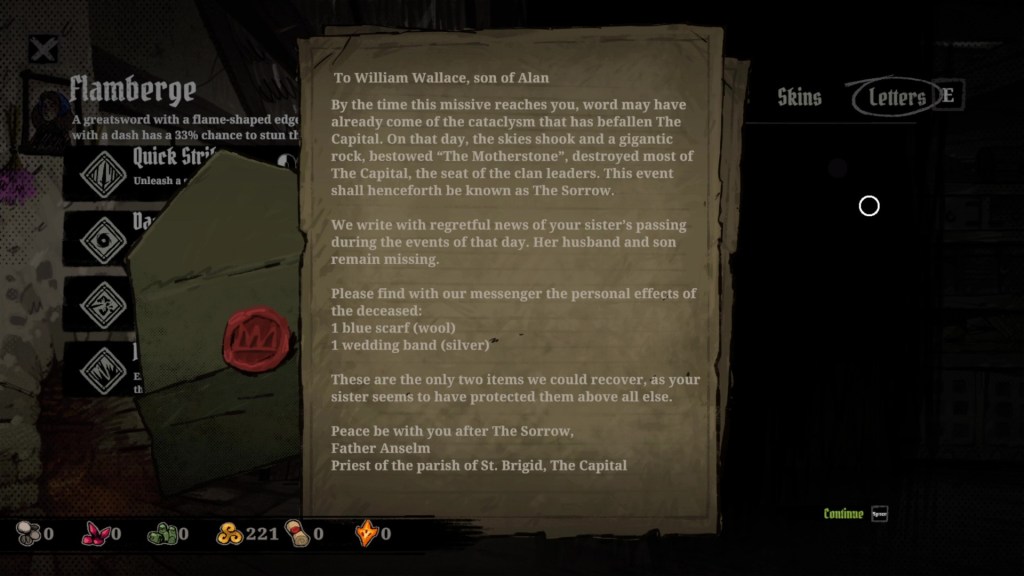
It doesn’t get much better off the battlefield either. One of Tears of Metal‘s grim surprises was waiting for me back at the home settlement where you can purchase more permanent and leader-specific upgrades, train up commanders, and check your game stats. While perusing for something that would help me against a mini-boss that narrowly beat me, I saw that there was a Letters section. In that section, there was only one item, worth the dirt cheap price of one coin. Taking the obvious bait, I paid the price and was met with a devastating note from the priest Father Anselm: William Wallace’s sister hadn’t survived the initial meteor strike. Additionally, both her husband and son are missing, making her currently survived by the blue scarf and wedding band she seemingly protected with her life.
Despite this being just a demo, loss is clearly a considered element in Tears of Metal. The game could’ve easily left all this emotional labor in the background, done somewhere that won’t distract from the player’s power fantasy as they lead an army to victory or death, but instead it chooses to weave in the grief that would inevitably loom over everyone in reality. I’m interested in seeing if this will be explored more in the full release of Tears of Metal, and whether or not it’ll make every sword swing feel heavier in the process.

 Exalclaw
Drop your thoughts!