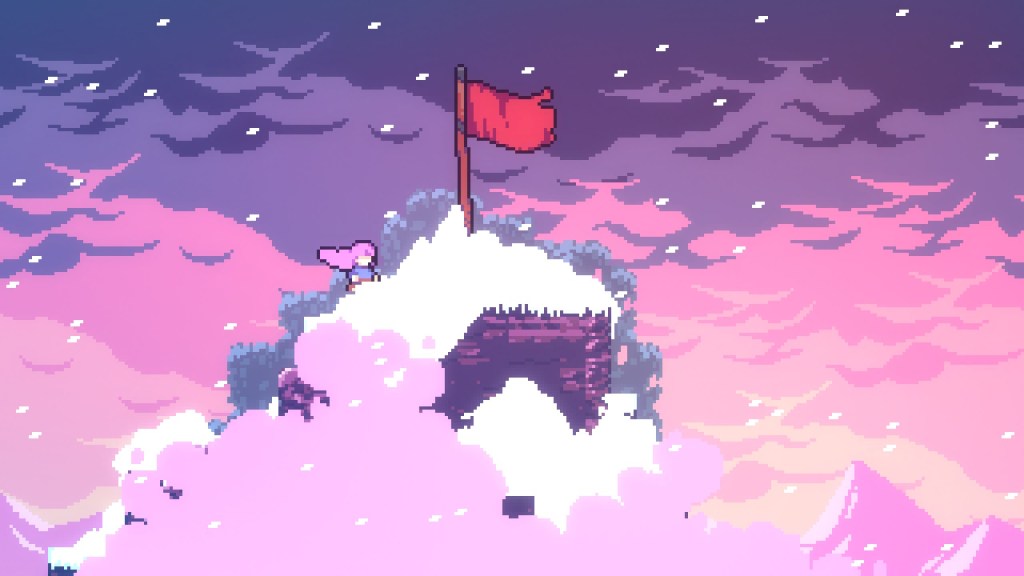
As someone who’s reached Mount Celeste’s peak several years later than others, there’s not many things I can add about Celeste. I’ve walked away thinking every ounce of praise I’ve heard was more than earned. It is a phenomenal game full of gorgeous 2D-pixel art, enchanting music, and stellar platforming exercises. These are all paired with a heartfelt story about a trans person dealing with anxiety, insecurity, triumph, and the parts of themselves they must reconcile with. Its optional challenges are difficult without being unfair or tedious, and always felt like they were truly asking me how well I understood the ways Mount Celeste can be climbed.
However, outside of its high quality, what’s going to keep this game in my favorites list is how I played it. Celeste will be the first game I completed in Spanish. While technically it was only after the first chapter that I visited the Options menu and made that switch to Spanish from English, most of my playthrough was spent putting years of self-taught Spanish to the test. My grade? I have a lot more work to do, but holy hell have I come much farther than I thought.
Similar to platformers, learning a new language is a great joy for me despite how frequently it makes want to bang my head against a wall. There’s tons of practical benefits to training your tongue to twist and turn and roll in unfamiliar ways, but personally I’ve always liked how much the world opens up when I start to piece together another language. From traditional stories to jokes to local news, knowing a language creates access to so many more things that come together to paint a clearer picture of entire cultures. Overall, language is an amazingly intimate thing that allows us to connect so much more with others. But, it’s also a pain in the ass to learn.
I have been learning Spanish on and off for almost 3 years now. I’ve tussled with the green owl and even racked up an impressive streak before leaving the app (I left before its AI pivot that slashed jobs). I watch YouTube videos (shout out to CuriosaMente and Spring Spanish) whose topics span the entirety of human existence, exposing me to new words and concepts in the process. I’ve watched seasons and half seasons of several telenovelas like Club de Cuervos and Money Heist to practice my comprehension. If I can wear headphones while doing anything, I’m frequently devouring podcasts that are teaching Spanish or telling stories in Spanish. I’ve loved doing all this. But, it’s hard.
Before Spanish, I spent over 5 years learning Mandarin Chinese in middle school and high school. I know the only reason I got to AP Chinese is because I had teachers who could answer questions and classmates who were down to practice. While I have no reason to rush my Spanish mastery, the lack of a classroom has made the language-learning mountain much taller and steeper. As a kid going to school, classes are compulsory. A language one is no exception, so there’s no extra work in making time for it. But as an adult with more responsibilities and other hobbies, I have to fit in learning. That requires significant amounts of intention and dedication, more than what’s already required to get through some of the inevitable tedium of learning something new, in addition to a willingness to try again when you inevitably fall off due to, frankly, life.
Right now, I’m back in one of my consistent phases and want to keep it going. This has meant looking for ways to diversify my learning experience, which finally brought me to trying to play a game in Spanish. I’ve thought about it before, and even briefly tried it one night while slaying gods in Cult of the Lamb, but ultimately never gave it a real shot. I don’t know why now — maybe I had a quiet confidence in my skill level gain since the last attempt, maybe Celeste’s whole “You can do this!” ethos clicked earlier than I realized — but something flipped a switch in my brain that made me play in Spanish.
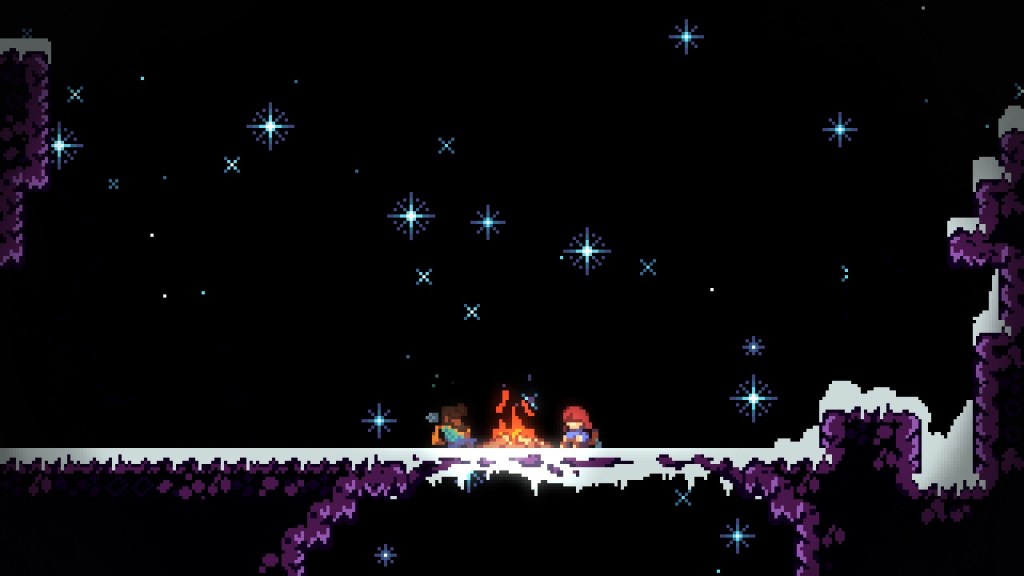
Initially, I was worried understanding a cutscene was going to be as difficult as collecting the strawberries littered across Mount Celeste. And admittedly, there are definitely a few things that completely went over my head. I didn’t know several words, and I didn’t whip out my Spanish dictionary app for all of them. However, I also knew several words. In fact, I knew a lot more than I expected, enough to get a bit more than the gist of Madeline’s troubles and observations, Theo’s words of advice and selfie requests, and Part of You/Me’s provocations and fears.
It also helps that video games have their own language that I’m very familiar with. Not all games present themselves the same, but there’s a level of formalization where even if I don’t know exactly what a word means, I know how to navigate an options menu. I can connect what I’m doing on screen with the unfamiliar prompt thrown at me. Surprisingly at first, a little obviously in hindsight, my knowledge of video games generally was coming in handy for learning what “pulsar A” means. This makes sense for a medium that encompasses so many moving parts. It has to teach the player how to interact with each part, but nonetheless it’s a nice discovery to see it has some unintended benefits outside of finishing a level.
The experience wasn’t without its pitfalls, but like Madeline, I shocked myself with what I could do. For all my doubts, the progress was undeniable. I haven’t reached the peak of my journey, and likely won’t for many years, but Celeste has shown me I’m a bit higher on the climb than I thought. For me, that makes it more than a great game — it’s now a major milestone I can look back on for the next time learning a new language feels like a herculean effort.

 Exalclaw
Drop your thoughts!