
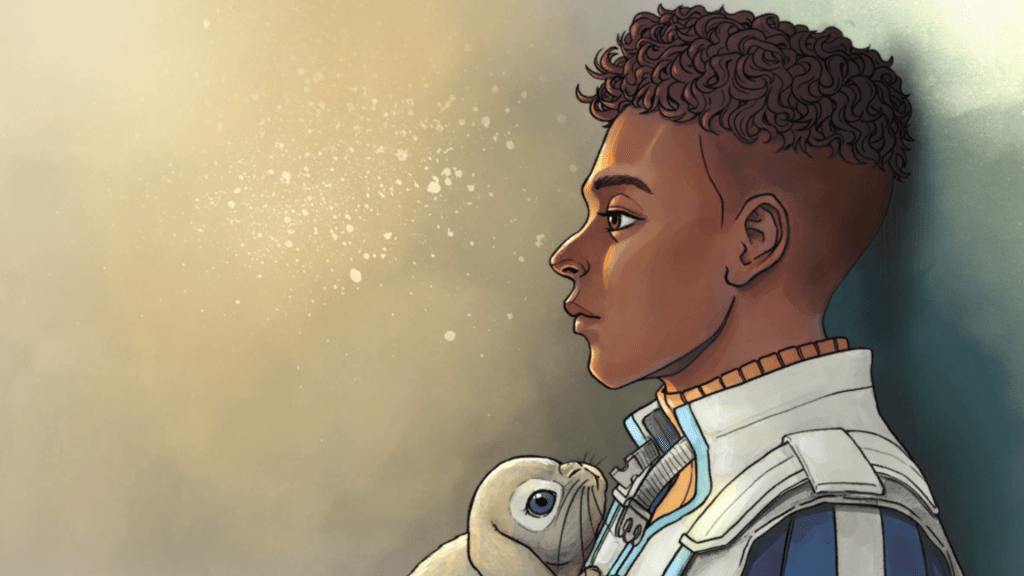
When I first recommended that Ocean get his gender-affirming surgery, I naively thought the cyberpunk visual novel Quality Dreams, Reasonably Priced would be an easy game for me to navigate. It’s not that the material wasn’t heavy — that was already foreshadowed by the litany of content warnings including but not limited to animals in peril, monetary struggles, and transphobia — but that this first decision was a no-brainer. I was in a position to help someone be who they knew themselves to be, to no longer compromise their existence in a way that left them unhappy, and it was as simple as saying yes to make that happen. And Ocean’s life clearly improved after that treatment.
But over my four hour playthrough, Quality Dreams, Reasonably Priced would go on to unravel the multiple ways that people are constantly forced to compromise their values, quality of life, and ultimately themselves due to the invisible systems bearing down on them. Despite the ease of this first decision, my stomach would later tie itself in knots when faced with the realities I couldn’t do more about.
In the lower levels of a city that grows vertically amid a barren wasteland, you will see clients at the body modification clinic Envisage Poetry as Jin (any/all pronouns). Officially a psychline, Jin toes the line between a (unlicensed) consultant and a salesman as they decide whether or not to recommend clients get surgery with the clinic’s surgeon, Dr. Sol. These recommendations will be based on interviews you conduct where strangers progressively become… strangers you know enough intimate details about to make a decision. This statement is not a jab at the writing, which is strong throughout most of the VN, but to emphasize that building meaningful connections takes more than an intake form and a short interview.
Stewing beneath these emotionally heavy conversations is Jin’s own predicament: barely getting by as is, Jin has been hit with the news that their pet bunny Nibbles Dandelion must undergo urgent surgery — a procedure that costs a heart-skipping $17,000 — or they will die. With less than two in-game weeks to scrounge together a sum larger than Jin’s savings, this slow-burning emergency is where the game begins asking players to explicitly interact with the complex pressures ordinary people face.
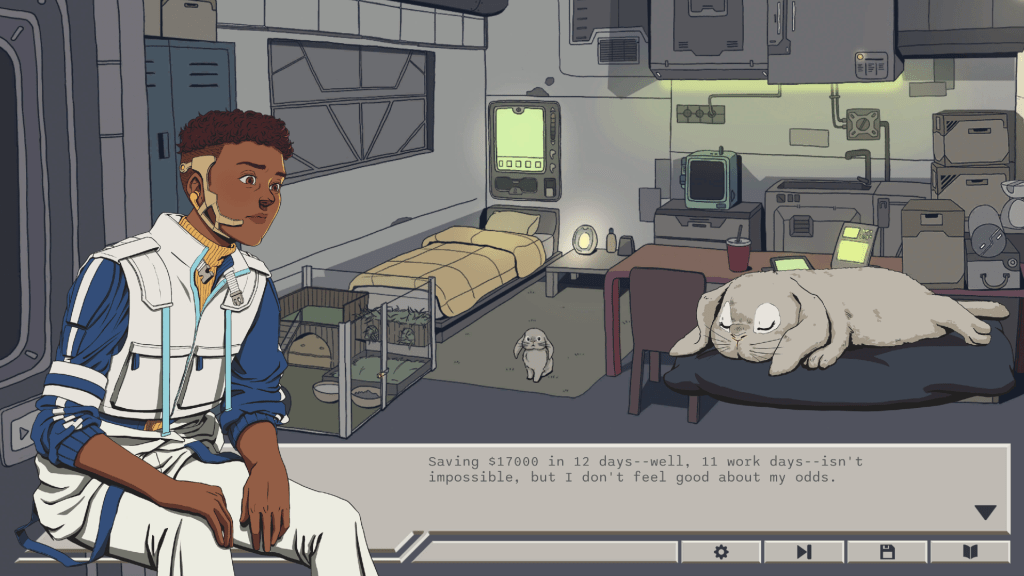
Jin earns a commission for every client who goes through a surgery, which itself adds a monetary incentive to recommend people more often than not. Factor in the unwell pet, and it’s easy to see how one’s thinking switches from focusing on reasons you should recommend a surgery to reasons you shouldn’t. I caught myself caveating every other thought I had about a specific patient with “but Nibbles Dandelion.” This mental asterisk is where morality and reality found themselves most explicitly clashing, a discussion it felt like the game was intentionally stirring in me with its frequent presentation of numbers and budget sheets next to Jin and their clients.
Speaking of the clients, what makes Jin’s dilemma more tumultuous is the characters Quality Dreams, Reasonably Priced throws at you. While I have my personal favorites (Ocean really becomes a breath of fresh air), none of the clients fit neatly into a “good” or “bad” person. There was never a time I went “Oh you suck, I’m not going to feel bad about draining your wallet.” I didn’t justify any recommendation or upsell based on my perception of another person’s ethics. Instead, I found myself dealing with average people who wanted to — or in several cases, felt the pressure to — modify their body for unique and often understandable reasons. Average people who, mostly, were coming to me with wallets already bleeding and had specific budgets to consider.
Take Clement, for example. Clement is a 48 years-old chef who works at one of the high-end restaurants in the city’s upper levels, one that pays them well enough to make rent and take care of their chronically ill partner Marin. When Jin’s intake with Clement starts, Clement shares that they want mods for improved stamina, coordination, and dexterity, as well as something for relieving bodily pain. The procedure itself would be a major boon for Jin commission-wise, but pre-existing health concerns on Clement’s end creates hesitation around a quick recommendation. It’s made clear that the risk isn’t significant, but the apprehension on both ends of the transaction is palpable.
As the conversation continues, it becomes clear that Clement’s desire for mods stems from their restaurant, at the mandate of its management, increasing in size without increasing staff numbers. This makes their job more physically labor-intensive than it already is. Moreover, Clement has already watched older staff get laid off as they lag behind greener, younger, and more exploitable co-workers. Feeling the pressure of higher-ups who are actively looking for a reason to fire them, as well as a future where they and Marin don’t know where their next paycheck will come from, Clement saved $16,000 to get mods that will help them keep up. Clement did not try to hide their mixed feelings about this procedure — due not only to being pressured into this situation, but also from losing out on their personal wish to see their body become naturally slower — but they were resolute by the time they sat in front of Jin.
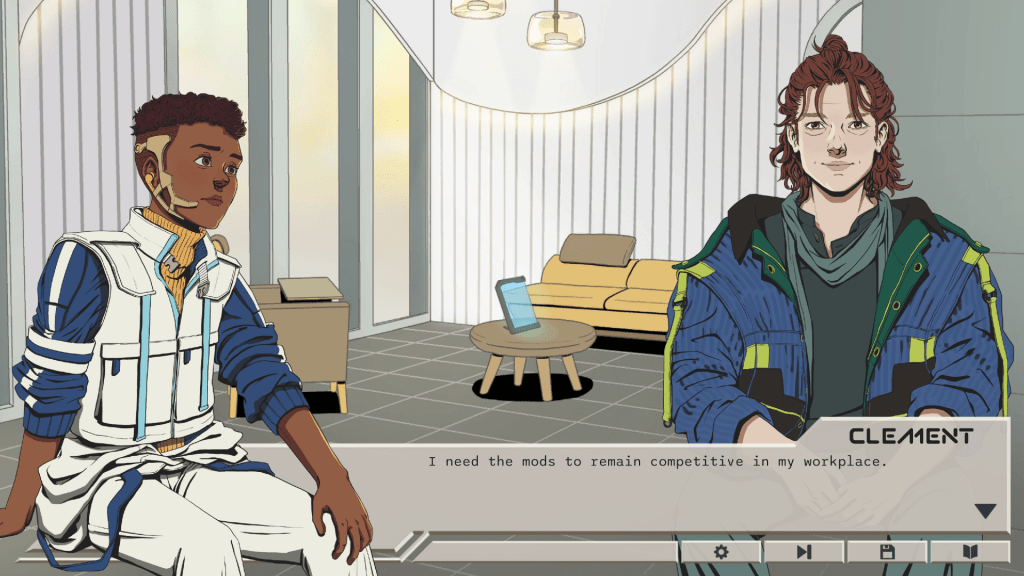
My journey to ultimately recommending Clement get their mods felt like a test of my will and then some. I wanted to scream at their higher-ups about how their blatantly profit-motivated move was forcing someone to compromise their wallet and long-term wishes, but then I realized that they likely know that and would have to be paid to care. I wanted to tell Clement that, with their experience, they could find a job somewhere else, but they had already made clear just how uncertain that path would be.
Hell, despite Clement’s clear wishes, a big part of me still wanted to say no after learning all this because of how deeply it compromised their agency and wishes — but the rest of me had to challenge that desire, because who was that helping? I would just become another person impeding on Clement’s agency. I would feel good on my personally constructed moral high ground while someone else would likely have to move down a couple of levels in the city. And again, what about Nibbles Dandelion? There are rarely miracles in real life where a lump sum of money appears in someone’s bank account. Quality Dreams, Reasonably Priced was no different.
I didn’t feel wrong handing Clement over to Dr. Sol for surgery, but I’d be lying if I said it felt good. It didn’t feel great when Clement returned later and shared that the mods were working well, and even earned them a pay raise, but that more staff had been laid off and their own workload once again increased. And this was how I felt after seeing most clients. Many, including Jin, were caught up in a complex web of pressures with no specific face, but controlled their lives with a gross and unyielding power. It’d be wrong to say that all of them were miserable, but many seem tired. Very tired.
It was impossible not to think about the current reality of millions of people in the U.S. and across the world as I played this game. In the U.S. specifically, the job market is awful right now. Before this, many people were already living paycheck to paycheck. And President Trump, in his absurd war against free speech, trans people, the LGBTQ+ community at large, immigrants, and essentially anyone he doesn’t like, has brought fascism to the country faster than most would’ve ever allowed themselves to believe. There are a near endless amount of other issues that could fit here, but the point is the same: millions are always dealing with external pressures, some visible and others not, that force them to see where they can cut a little of themselves out to make it to tomorrow. Quality Dreams, Reasonably Priced captures this in a way that refuses to yield on the fact that the current way of doing things fundamentally does not allow people to be their full selves.
With all the above in mind, I’d like to end off by bringing attention to the compromised conditions this game was made under. This visual novel is the debut work of Zorkie Studios, a two-person indie studio where one developer is based in Canada and the other in Indonesia. At the end of the visual novel, the team speaks directly to the player through a note to share some of the struggles going on in their regions.
Speaking first on Canada, where the game was primarily developed in Toronto, the note shares in part that “the rights of Indigenous Peoples are being violated. Settler-colonialism is and has been actively dismantling their connection to the land and their cultures through historic and ongoing genocide. We encourage settlers to unlearn their colonial history, deconstruct their privilege, and learn about Indigenous cultures and settler responsibilities. In this way, we learn the truth of the land we live on and reject Indigenous erasure and colonial myths.” This statement is followed by “We want to highlight the global Land Back movement, which aims to return land to Indigenous peoples. By returning land, self-governance and environmental stewardship are returned as well. The Land Back movement is led by Indigenous people, and we emphasize the importance of listening to Indigenous people and following their leadership as we act towards land return and reconciliation.”
The note later brings up Bandung, Indonesia, another area where the game was developed, and shares that “it is hard to speak about developing queer games and hard to know who to trust with one’s words. We test the waters and tread lightly, employing effort where the energy feels warranted.” It follows this up by stating “Queer people have always existed and will never stop existing. They were here on Turtle Island before the settler-colonists came. We are here even when we are not wanted; we don’t have a choice. Queerness exists whether we can speak its name or not.”
I reached out to the team to see if there were any resources they’d suggest for those interested in learning more about the Land Back movement and Indonesia’s treatment of queer game developers. For the former, Zorkie studio recommends reading “Land Back: A Yellowhead Institute Red Paper,” as well as Arthur Manuel’s “6 steps to decolonization” from The Reconciliation Manifesto. As for the latter, the following statement was provided: “For Indonesia’s treatment of queer people, we don’t have resources, just first hand accounts. We’d appreciate it if people would listen to and uplift queer personal stories when they find them, particularly from places like Indonesia where these stories aren’t told as often.”


 Exalclaw
Drop your thoughts!